Dr. Refael Aharon
Inventor • Scientist • Entrepreneur • System Builder
Patented technology • Working machinery • Wastewater → Textiles → Advanced materials
More than two decades of patented work in wastewater resource recovery, cellulose, nanocellulose, textile processing, and industrial systems.
Waste Is Not the End. It Is a Resource Waiting to Be Recovered.
For more than two decades, my work has focused on a practical idea: waste should be engineered as a source of valuable materials, energy, water, and infrastructure—not simply managed as a disposal problem.
I work across the full innovation path:
SCIENCE → IP → ENGINEERING → MACHINERY → MATERIALS → SCALE-UP
My current work is developed through two distinct technology ventures: Harvest Nano and Waste2Nano.
Pioneering Waste Mining
Practical Science for Difficult Real-World Problems
I have spent more than two decades working on a simple but demanding question: what valuable resources are hidden inside the waste streams that are hardest to manage?
My approach has always been practical. I am a scientist by training, but my work does not stop with research, publications, or patents. I focus on taking scientific principles into the physical world—designing processes, building machinery, operating pilot systems, producing real materials, identifying failures, and improving technologies until they can address real industrial problems.
That philosophy led me early in my career to what I call Waste Mining: treating waste not simply as something to dispose of, but as a resource containing materials, water, energy, and economic value that can be recovered.
I began applying that thinking to one of society’s most difficult waste streams: municipal wastewater and sewage solids. Instead of accepting sludge as an unavoidable treatment by-product, I worked on systems designed to recover cellulose-rich material before it became conventional sludge and to transform that recovered material into useful industrial feedstock.
The same engineering philosophy later expanded into other complex waste streams. Post-consumer textile waste presents a different but equally difficult challenge. Used clothing is heterogeneous, contaminated, chemically treated, and increasingly composed of difficult fiber blends. Solving that problem requires more than recycling equipment—it requires intelligent sorting, contamination awareness, material separation, process chemistry, machinery, and a valuable final product.
That work became the foundation of Harvest Nano’s textile platform: combining Smart Sorting, contamination-aware processing, cellulose recovery, microcellulose, and nanocellulose production.
Today, through Waste2Nano, I am extending the same Waste Mining philosophy into the intersection of wastewater infrastructure and next-generation computing—looking at wastewater, waste heat, sewage solids, PFAS, microplastics, and data-center cooling as parts of one connected engineering system.
Across these projects, the waste stream changes, but the method remains the same:
Understand the waste → Identify the hidden value → Develop the IP → Build the machine → Operate the process → Produce the material → Scale the system
I am most interested in problems that are considered too dirty, too complicated, too variable, or economically unattractive for conventional solutions. That is where practical science matters most.
Waste Mining is not simply a sustainability concept. It is the engineering discipline of finding value where others see only waste, and building the systems required to recover it.
One Engineering Philosophy
Waste Mining
Mining begins by identifying something valuable and developing the technology required to recover it. Waste Mining applies that same logic to resources society has already extracted, manufactured, used, and discarded.
Instead of asking only, “How do we dispose of this waste?” I ask: “What valuable material, water, energy, or infrastructure opportunity is still inside it, and how can we recover it economically at meaningful scale?”
That question connects more than two decades of my work across wastewater recovery, cellulose, nanocellulose, textile circularity, Smart Sorting, contamination management, and next-generation infrastructure.
From Patent to Machine: Invention Is Only the Beginning
A patent can describe an invention. Making an invention work in the physical world requires something more. My work has focused on combining intellectual property with practical engineering knowledge:
Machinery • Chemistry • Feedstock Behavior • Process Integration • Operating Experience • Troubleshooting • Contamination Control • Testing • Scale-Up
The most valuable engineering knowledge is often found in the integration: how components interact, which approaches fail, how variable feedstocks behave, how a laboratory result becomes reliable machinery, and how a process is adjusted when real-world conditions change.
The objective is not simply to develop an idea. It is to build a functioning system.
Explore the Work
About
Two decades of invention across biotech, materials science, and clean technology, spanning laboratory research, patent development, and hands-on machine building. This page traces that full arc, from early biotechnology work through the engineering philosophy that connects everything since.
Harvest Nano
Turning post-consumer textile waste into cellulose, microcellulose, and nanocellulose through a platform that combines Smart Sorting, contamination-aware processing, and material recovery, built on a documented pilot system that produced cellulose-based material outputs.
Waste2Nano
Connecting wastewater infrastructure to next-generation AI data center cooling by treating cooling demand, waste heat, wastewater solids, PFAS, and microplastics as parts of one connected resource system rather than separate problems.
The Waste Mining Revolution
The Book Behind the Philosophy
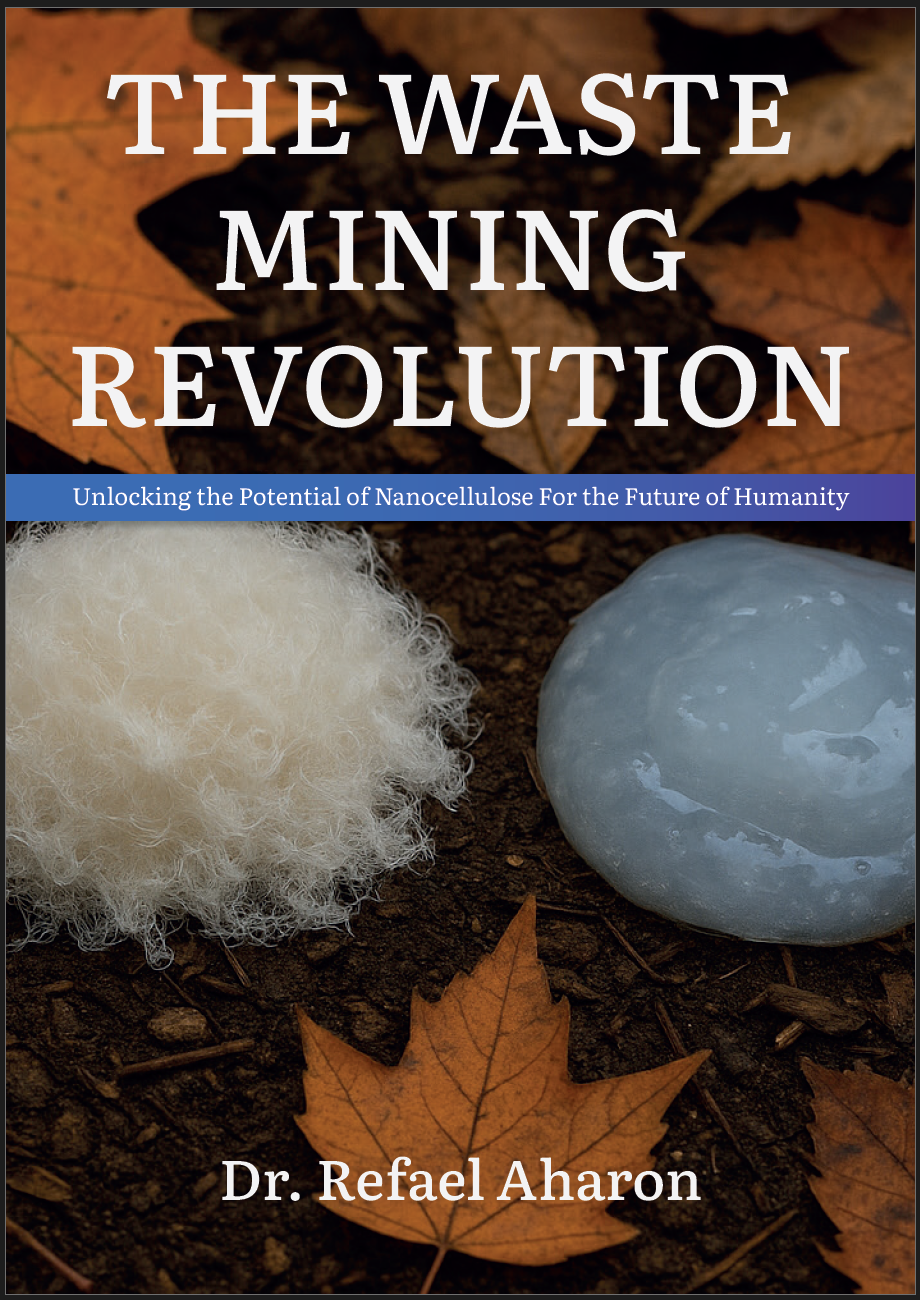
The Waste Mining Revolution presents the broader philosophy connecting this work. The central idea is simple: environmental solutions become more scalable when waste is treated as an economic resource rather than only as an environmental liability.
The book explores the relationship between waste, engineering, material recovery, nanocellulose, economics, circularity, and infrastructure. It is written for people interested in moving beyond waste management toward resource recovery and practical circular systems.
Dr. Refael Aharon
Inventor • Scientist • Entrepreneur • System Builder
Harvest Nano | Waste2Nano | Waste Mining
Turning waste streams into material and infrastructure opportunities.
Technology descriptions are high-level public summaries and do not disclose confidential know-how or alter any intellectual-property, licensing, or ownership rights. Patent status should be confirmed through official patent-office records.
© 2026 Dr. Refael Aharon. All rights reserved. Public descriptions are provided for informational purposes only and do not waive, assign, license, or otherwise alter any intellectual-property, confidential-information, trade-secret, or other proprietary rights.

